When Humor Crosses Languages: Translating Jokes Between Arabic and English
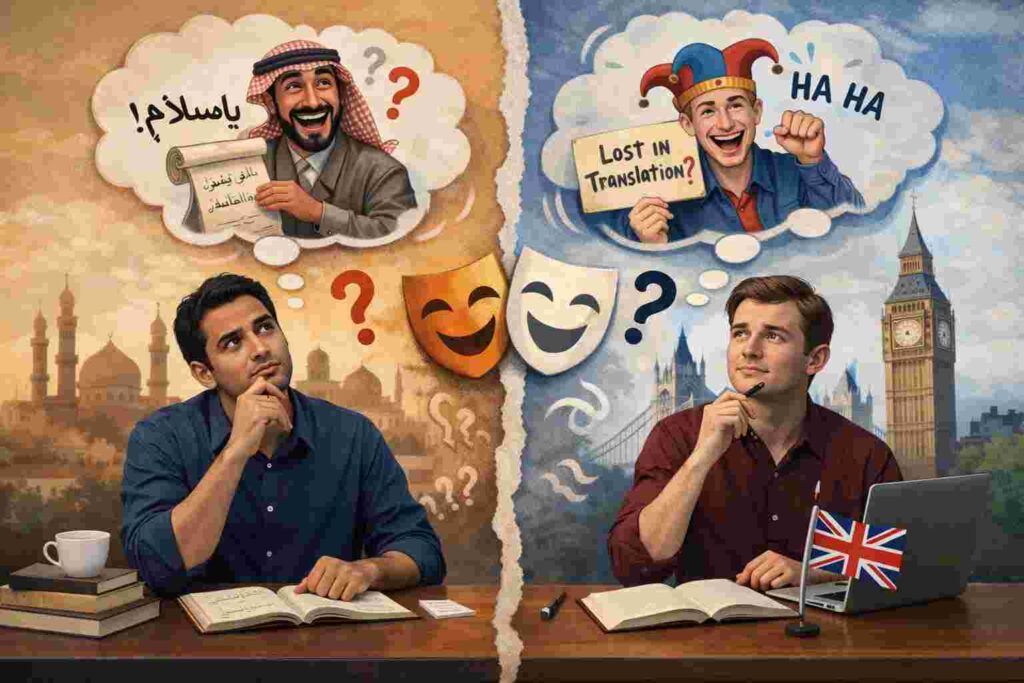
Humor is often the first casualty when moving between Arabic and English. Not because either language lacks wit, but because they make people laugh in different ways. Arabic humor frequently draws on exaggeration, shared social understanding, and expressive tone, while English humor tends to favor understatement, irony, and linguistic precision. When a joke crosses between these two systems, translators quickly find themselves asking questions that rarely come up with other types of text.
One of the earliest doubts is whether the joke should be preserved at all. Translators often hesitate, wondering if they are allowed to change a joke or whether doing so crosses an invisible professional line. This uncertainty becomes sharper when the joke is built on wordplay. English puns, for example, often depend on double meanings that simply do not exist in Arabic. Translating them literally keeps the words but loses the humor, raising a quiet but persistent question: is it better to stay close to the text or close to the laugh?
The same tension appears in reverse. Arabic jokes may rely on metaphor, dramatic exaggeration, or culturally loaded expressions that sound overly serious or confusing when translated into English. In these moments, translators find themselves asking how much adaptation is too much. Replacing an Arabic expression with a more familiar English equivalent may preserve the effect, but it can also feel like a betrayal of the source culture. Leaving it untouched, however, risks losing the reader entirely.
Cultural distance complicates matters further. Many Arabic jokes assume shared knowledge—family hierarchies, religious expressions, political realities, or regional stereotypes. When an English-speaking reader does not share this background, the humor disappears unless the translator intervenes. But intervention brings another dilemma: should the joke be explained, knowing that explanation drains it of life, or should it be quietly reshaped into something the target audience can recognize without effort?
Timing adds yet another layer of difficulty. Arabic humor often unfolds gradually, allowing repetition and rhythm to build toward a humorous effect. English comedy, by contrast, frequently relies on brevity and sharp punchlines. Translators adjusting sentence length and structure may wonder whether the joke will still register as humor at all, or whether the reader will miss it entirely and read the line as oddly phrased or unintentionally rude.
These concerns become even more acute in interpreting. Without the luxury of time, interpreters must make split-second decisions: paraphrase the joke, signal humor indirectly, or let it pass. Many worry about how much freedom they have in the moment, and whether altering or dropping a joke changes the interaction in ways they cannot control.
Underlying all of this is a deeper anxiety about responsibility. What happens when a joke is harmless in Arabic but offensive in English, or vice versa? Translators often ask themselves whether they are accountable for the impact of humor in the target culture, and whether softening or neutralizing a joke compromises the speaker’s intent. This question becomes especially pressing in professional or institutional settings, where humor can easily be misread.
In exam contexts or client work, another concern quietly shapes decision-making: what will be expected? Translators may know instinctively that a joke needs adaptation, but fear that creativity will be judged as inaccuracy. The result is often a cautious compromise that preserves meaning but sacrifices humor, even when the translator knows a bolder choice would have served the text better.
Ultimately, translating jokes between Arabic and English is not about finding perfect equivalents. It is about navigating uncertainty with sensitivity and purpose. Every joke forces the translator to weigh loyalty against clarity, culture against accessibility, and words against effect. When done well, these decisions disappear into the text. The reader laughs—or at least feels the lightness intended—without noticing the careful negotiation that made it possible.
That invisibility is not accidental. It is the result of a translator who understood that humor cannot be transferred mechanically. It must be reimagined, reshaped, and sometimes quietly let go, all in service of the same goal: allowing the joke to live, even when the words cannot.