Consecutive vs Simultaneous Interpreting: What’s the Real Difference?
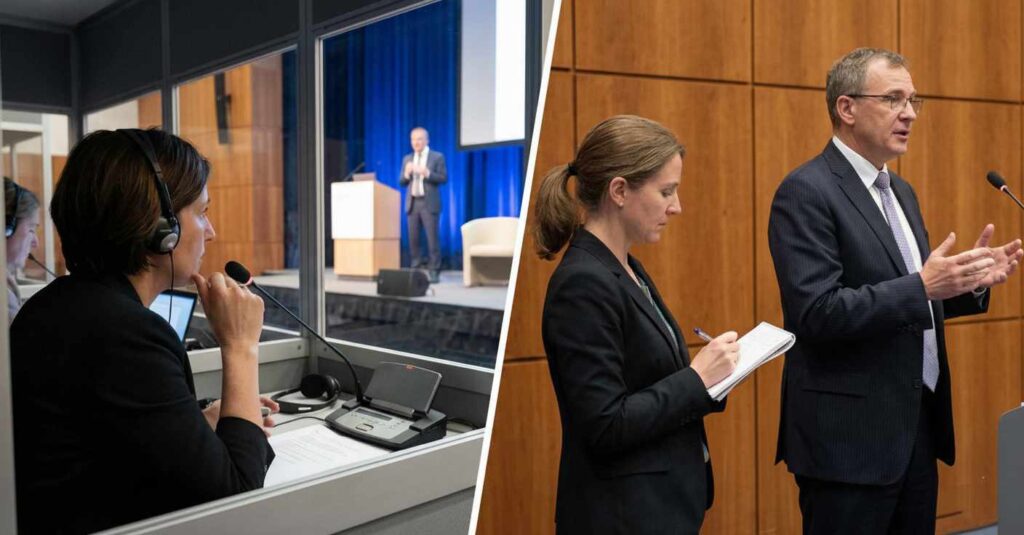
If you’ve ever booked an interpreter in Australia—whether for court, a hospital appointment, or a government interview—you may have heard the terms consecutive and simultaneous interpreting. While they sound technical, the difference between them has a real impact on how communication happens, how accurate it is, and even how much the service costs.
At its core, the difference comes down to timing.
In consecutive interpreting, the speaker pauses every few sentences to allow the interpreter to relay the message into the other language. This is the style most Australians encounter in legal settings, medical appointments, Centrelink interviews, and police matters. It allows the interpreter to focus carefully on meaning, tone, and detail before delivering an accurate interpretation.
Simultaneous interpreting, on the other hand, happens almost at the same time as the speaker is talking. There are no pauses. The interpreter listens and speaks concurrently, usually through special equipment such as headsets and soundproof booths. This mode is most common at conferences, large seminars, and international events.
Because of the mental load involved, many interpreters consider simultaneous interpreting more demanding. Interpreters are processing, translating, and speaking all at once, with no time to stop, rethink, or clarify. Consecutive interpreting is also challenging, but it allows brief pauses, making it more suitable for situations where accuracy and legal or medical consequences matter.
That’s why in Australia, courts, hospitals, and government agencies almost always rely on consecutive interpreting. In these settings, accuracy takes priority over speed. Even a small misunderstanding can have serious outcomes, whether it’s a diagnosis, a legal decision, or a visa matter. Consecutive interpreting gives interpreters the time they need to be precise, especially when complex terminology or emotional content is involved.
From an accuracy perspective, consecutive interpreting is generally considered the gold standard for one-on-one and sensitive interactions. Note-taking plays a big role here. Interpreters use specialised techniques to capture key ideas, numbers, names, and sequences without writing everything verbatim. While note-taking may also be used occasionally in simultaneous interpreting, it is far more central to consecutive work.
So how is the interpreting mode chosen? In Australia, the decision is usually based on the setting, number of participants, level of risk, and purpose of the interaction. A medical appointment or court hearing will almost always call for consecutive interpreting, while a multilingual conference with hundreds of attendees requires simultaneous interpreting to keep things moving efficiently.
Many professional interpreters are trained in both modes, but not everyone offers both services regularly. Simultaneous interpreting requires additional training, equipment, and often teamwork—interpreters usually work in pairs and rotate due to fatigue. Consecutive interpreting, while still highly skilled, is more commonly requested and widely practised in community settings.
When it comes to pay, simultaneous interpreting generally pays more per hour in Australia. This reflects the higher level of intensity, preparation, and technical requirements involved. However, consecutive interpreting is far more common, meaning many interpreters build sustainable careers primarily through legal, medical, and community work.
If you’re unsure which type of interpreting you need, working with a qualified NAATI-certified interpreter makes all the difference. A professional will assess your situation and ensure the right interpreting mode is used—protecting accuracy, confidentiality, and fairness.
If you’re looking for reliable Arabic–English interpreting or certified translation services in Australia, you can find more information about my services on my website. I provide NAATI-certified interpreting for legal, medical, and community settings, as well as certified translations for official documents such as birth certificates, marriage certificates, passports, and more.
Clear communication isn’t just about language—it’s about choosing the right method to make sure nothing important is lost.